
Welding Engineering Process Map
Welding Engineering Process Map — Command Centre
Select the welding-engineering activity that matches the task in front of you. This is the dedicated command centre for the discipline. These are independent guide entities, not one compulsory chronological sequence.
Core Welding Engineering
Additional Guides
Weld Production Monitoring
Weld Production Monitoring
A field guide for the welding engineer, coordinator or inspector monitoring production welding in a workshop or on site.
Production Monitoring — Field Mode
A touch-based temporary checklist for Welding Engineering surveillance in a workshop or on site. Ticks and notes are stored locally on this device only; this does not replace the ITP, formal QC inspection, hold-point release, NCR system or controlled project records.
Production Monitoring — Visual Route
1. Before Welding
WPS, materials, fit-up, consumables, welder qualification and equipment.
2. During Welding
Parameters, preheat/interpass, gases, technique and consumable control.
3. After Welding
Traceability, visual condition, PWHT release and inspection/NDT handover.
4. Record / Escalate
Document observations and escalate deviations before work proceeds.
Purpose
To verify that production welding is being carried out using the approved welding procedure, qualified personnel and specified controls, and to identify deviations before they become embedded in the work.
When to use this Guide
During fabrication, construction, site welding, production surveillance, first-off welding, critical welds, repair welding or whenever Welding Engineering needs to verify actual welding practice.
Why this matters
An approved WPS only controls production if it is actually followed. Monitoring provides assurance that joint preparation, consumables, temperatures, parameters, technique and traceability remain within the approved requirements.
Information you need
Drawing/isometric and weld ID, approved WPS/revision, applicable specification/ITP, material identification, welder ID/qualification, consumables, equipment/calibration status and inspection requirements.
Before Welding
- Confirm the correct approved WPS and current revision are available at the work location.
- Confirm the weld/joint identity and material against the drawing/isometric and traceability records.
- Check the joint preparation, root gap, alignment/fit-up, cleanliness and backing/purge arrangement as applicable.
- Confirm the welder/operator is suitably qualified for the work.
- Verify consumable classification, condition, batch/control and storage/handling requirements.
- Confirm welding equipment is suitable and required calibration/validation status is current.
- Check environmental and access conditions where they can affect welding quality.
During Welding
- Confirm preheat is achieved where required and monitor interpass temperature.
- Verify welding process, polarity/current type and technique against the WPS.
- Monitor actual current, voltage and travel speed/heat input where required.
- Check shielding/purge gas type, flow and protection where applicable.
- Observe bead sequence, cleaning between runs, inter-run grinding and removal of defects as applicable.
- Confirm consumables remain controlled and identifiable.
- Record any deviation and stop/escalate the activity where the approved WPS or project requirements are not being followed.
After Welding
- Confirm weld identification and welder traceability are complete.
- Review visual condition and any immediate production inspection requirements.
- Confirm PWHT or other post-weld controls are initiated where applicable.
- Ensure required NDT/inspection is requested or released in accordance with the ITP/project requirements.
- Record observations, deviations and any required engineering follow-up.
Decision Points
Is the correct WPS being followed? Is the welder qualified? Are parameters/temperatures within the approved range? Has a deviation occurred? Should welding continue, be placed on hold, or be escalated for engineering/project disposition?
Who you may need to involve
Production/Fabrication, Quality Control, NDT, Project Engineering, Materials/Metallurgy, client inspector and certifying authority where applicable.
Outputs / Records
Production-monitoring checklist/record, parameter observations, photographs where appropriate, deviation/hold-point record and engineering follow-up actions.
Related Guides
WPS / PQR-WPQR Information Control · Welder Qualification & Performance · Joint Design · Materials & Consumables · Weld Repairs.
Escalation / Stop-Work Triggers
Escalate or place welding on hold where the approved welding basis is unavailable or unsuitable, welder qualification cannot be confirmed, materials/consumables are unverified, preheat/interpass temperatures or other specified production controls are outside the approved basis, environmental conditions invalidate the WPS/method, or an uncontrolled deviation is identified.
Where the issue is safety-related, follow the site stop-work / HSE escalation process rather than treating it only as a welding-quality issue.
WPS / WPQR
Matching procedures
| Reference | Material | Process | PWHT | Status |
|---|---|---|---|---|
| WPQR-015 | Duplex 2205 | GTAW/SMAW | As welded | Candidate |
| WPS-021 | Duplex 2205 | GTAW/SMAW | As welded | Review required |
Joint Design
Joint Design
Select and review the joint configuration with welding process, access, qualification and inspection requirements in mind.
Purpose
To guide the welding engineer through the principal considerations when selecting or reviewing a weld joint design.
When to use this Guide
When preparing or reviewing a WPS/pWPS, reviewing drawings or isometrics, planning a qualification test, assessing a repair joint, or checking WPS/WPQR coverage.
Why this matters
Joint geometry affects accessibility, penetration, weld-metal volume, heat input, distortion, inspection and qualification coverage.
Information you need
Material, thickness/diameter, drawing, applicable code/specification, welding process, access/position, penetration requirements, NDT requirements and applicable WPS/WPQR.
Welding Engineer Activities
- Confirm the joint type and required function from the design/workscope.
- Confirm material, thickness, diameter/product form and service requirements.
- Review applicable code, client specification and drawing requirements.
- Select/review a preparation compatible with the intended welding process and access.
- Consider root face, root gap, included angle, backing/back-gouging and penetration as applicable.
- Consider welding position, accessibility and practical welding sequence.
- Consider weld-metal volume, heat input, shrinkage and distortion.
- Confirm required inspection/NDT access.
- Check that the proposed configuration is within WPS/WPQR qualification.
- Document the accepted preparation in the appropriate controlled document.
Main Joint Designs — Illustrated Guide
Square Butt
Square edges with a controlled root opening where required.
Single V Butt
Single-sided groove preparation with included angle, root face and root gap.
Double V / X
Double-sided preparation; symmetrical or unsymmetrical arrangements may be used.
Single U
Curved preparation used mainly on thicker sections to reduce weld-metal volume.
Single J
One member square, the other machined to a J preparation; useful where access/preparation dictates.
T / Fillet
T-joint shown with bilateral fillet welds; groove preparations may be required for penetration.
Lap Joint
Overlapping members normally joined by one or more fillet welds.
Corner Joint
Members meet at an angle; fillet or groove welding may be used.
Branch Connection
Branch-to-main connection requiring attention to fit-up, access, penetration and qualification.
Educational schematics only. Actual dimensions and preparation requirements must come from the applicable design, WPS and governing code/specification.
Decision Points
Can the joint be welded and inspected as proposed? Is complete penetration required? Is access available from one or both sides? Is it covered by the WPS/WPQR?
Who you may need to involve
Design/Project Engineering, Fabrication/Production, Quality Control/NDT, client and certifying authority where required.
Materials & Consumables
Materials & Consumables
Identify parent materials correctly and select welding consumables compatible with the process, service and project requirements.
Purpose
Guide the material and consumable information that must be established before selecting, reviewing or qualifying a welding procedure.
When to use this Guide
During WPS/WPQR search, WPS Proposal, qualification, joint review, repair planning or material/consumable assessment.
Why this matters
Incorrect material identification or consumable selection can invalidate qualification coverage and produce unsuitable weld properties.
Information you need
Material specification/grade, product form, thickness, supply/heat-treatment condition, material certificates, service conditions, code/client specification, welding process and required weld properties.
Welding Engineer Activities
- Identify the parent material specification and grade from controlled information.
- Confirm product form, thickness and relevant supply/heat-treatment condition.
- Review certification and traceability where required.
- Establish the applicable material grouping/classification used by the governing qualification code.
- Identify supplementary project/service requirements affecting welding/testing.
- Assess relevant weldability considerations.
- Select a consumable classification compatible with material, process and required properties.
- Confirm required strength, toughness, hardness, corrosion or other weld-metal properties as applicable.
- Confirm shielding/purge gas and consumable handling/storage requirements where applicable.
- Check the selected combination is supported by the WPS/WPQR or identify the need for qualification.
Decision Points
Is the material positively identified and within an existing qualification range? Are special service properties required? Is the consumable compatible and qualified?
Who you may need to involve
Materials/Metallurgy, Project Engineering, Quality Control, Procurement, supplier, client and certifying authority where applicable.
Outputs / Records
Confirmed material identification/grouping, selected consumable classification and documented input to WPS/WPQR or qualification activities.
Related Guides
WPS / PQR-WPQR Information Control · WPS Proposal · Joint Design · WPS / PQR-WPQR Testing · Weld Repairs.
Codes & Standards
Codes & Standards
Establish which requirements govern the welding activity and how project/client requirements interact with the construction and qualification codes.
Requirements Hierarchy
Before reviewing a WPS, qualification or fabrication issue, establish the complete governing document set. A typical project may include legislation/regulation, construction code, welding qualification standard, client/company specification, project specification, drawings, ITPs and approved concessions/deviations.
Purpose
Guide the user in identifying and organising the codes, standards, client specifications and project documents applicable to a welding-engineering task.
When to use this Guide
At the start of a WPS/WPQR review, WPS Proposal, welder qualification, weld repair, production-monitoring activity or any technical review where acceptance depends on defined requirements.
Why this matters
Different documents control different aspects of the work. The welding engineer must know which document governs design/fabrication, procedure qualification, welder qualification, inspection/testing and any additional client requirements.
Important limitation
WeldEng will guide users to the relevant requirement categories and references but will not reproduce copyrighted standards. The contractually applicable controlled edition/revision of the governing code, standard or specification remains the authoritative source.
Welding Engineer Activities
- Identify the governing construction/design code from the project/workscope.
- Identify the applicable welding procedure qualification standard/code.
- Identify the applicable welder/operator qualification requirements.
- Identify client/company specifications that supplement or modify the base code requirements.
- Review the project ITP, drawings, data sheets and other documents that impose welding/inspection requirements.
- Establish document revision/status and confirm the correct editions are being used.
- Identify conflicts, ambiguities or additional requirements requiring clarification or concession.
- Record the applicable requirements/references for use in the welding-engineering activity.
Reference families
Construction/design codes · WPS/WPQR qualification standards · Welder qualification standards · NDT/testing standards · Material/consumable standards · Client/company specifications · Project ITP/drawings.
Outputs / Records
Defined applicable-document list, revision/edition status, identified supplementary requirements and any clarification/concession actions.
Welder Qualification & Performance
Welder Qualification & Performance
Answer the practical question: “Is this welder qualified for the weld we need them to make?”
Welder Qualification — Visual Route
1. Define the Required Scope
Process, material, product type, thickness/diameter, position and project requirements.
2. Check Existing Qualification
Search the qualification register/certificates and verify validity and coverage.
3. Test if Required
Define and control the welder qualification test using the applicable WPS and standard.
4. Certify / Maintain
Issue/update qualification records and maintain the approved-welder status.
Typical Documents
VT / NDT / Mechanical tests as required by the governing qualification route.
Process / material / thickness / diameter / position / other applicable variables.
Typical Welder Qualification Certificate
A controlled record showing the test conditions, results and qualified range for the individual welder.
Historic weld activity, project performance and supporting records where required.
Typical Welder Qualification Register
Provides a controlled overview of qualified welders and current qualification status.
Purpose
To ensure that welders assigned to production work hold suitable, current qualifications for the required welding activity and that their status is properly controlled.
When to use this Guide
When selecting a welder for a project, checking an existing certificate, arranging a new qualification test, renewing/updating qualification status or reviewing project welder records.
Why this matters
A welder may hold several certificates yet still fall outside the scope required for a particular production weld. The certificate and its current validity/continuity evidence must be assessed against the actual work.
Information you need
Project welding requirement, governing qualification standard, WPS, welder identity, existing certificates, required process/material/joint/position, test requirements and any client/certifying-authority requirements.
Is the Welder Already Qualified?
Governing Standard
Confirm which welder qualification standard applies and whether the client/project adds further restrictions.
Welding Process
Confirm each production welding process requiring performance qualification is covered by the welder's qualification evidence.
Material / Product Type
Check the material/filler grouping or other material-related performance variables required by the selected qualification standard; do not assume procedure-qualification material rules are identical to welder-performance rules.
Thickness / Diameter
Compare the required production dimensions against the qualified range stated or established from the governing standard.
Joint / Backing
Check butt/fillet/pipe configuration, backing/root condition and any other joint variables relevant to the qualification.
Welding Position
Confirm position and, where applicable, vertical progression or fixed/rotated pipe condition.
Consumable / Technique
Review the filler-metal, transfer/deposition mode, backing/root and technique variables that the governing performance-qualification route actually controls.
Validity / Continuity
Confirm that the qualification remains valid under the selected standard and that the required continuity/confirmation evidence is current and traceable.
Project Acceptance
Confirm client/certifying-authority endorsement or project-specific acceptance where required.
May be assigned within the confirmed scope.
Certificate, continuity or project acceptance needs clarification.
The existing qualification does not cover the required work.
If New Qualification Testing Is Required
- Define the qualification scope required by the project/workscope.
- Identify the applicable qualification standard and the WPS to be used for testing.
- Prepare the qualification request with all appropriate test information.
- Coordinate test facilities, programme and witnessing requirements.
- Ensure the test weld is correctly identified and the welding conditions are controlled.
- Arrange/review the required examination and testing.
- Compile the welder qualification certificate from the accepted test results.
- Submit for client/certifying-authority endorsement where required.
- Update the welder qualification register and communicate the approved status.
Qualification Maintenance / Update
The qualification-control methodology treats qualification maintenance as a controlled activity, not merely a certificate-expiry date. Project weld history and NDE/performance information are retained and fed back through Personnel/HR to Welding Engineering to support qualification validation/update.
Project Weld History
Maintain records of welding performed by the welder on the project.
NDE / Performance Evidence
Retain relevant project NDE results/performance information supporting qualification maintenance.
Qualification Register
Update the controlled welder register and qualification summary/status.
Endorsement
Where required, submit updated qualification information to the certifying authority/client for endorsement.
Who you may need to involve
Personnel/HR, project requisitioner, Quality Control, testing facility/test house, Commercial where qualification costs require approval, client and certifying authority as applicable.
Outputs / Records
Welder qualification request, test records, examination/test reports, welder qualification certificate, updated welder qualification register, qualification summary/ID information and maintenance/continuity evidence.
Select the Welder Qualification Route
EN ISO 9606-1
Active guidance route for steel welder qualification assessment.
ASME Section IX
Active performance-qualification guidance route.
Other / Project-Specific
Controlled route for another governing qualification basis.
NDT & Mechanical Testing
Weld Repairs
Weld Repairs
Assess, plan, control and verify a weld repair as a distinct welding-engineering activity.
Weld Repair — Field Guide
Use this route when a weld indication, discontinuity or rejectable defect requires engineering review. It guides the sequence from characterisation through repair close-out without assuming that every indication requires repair.
1. Characterise the Indication
Review the inspection/NDT report, location, size, orientation, examination method and whether the indication is surface-breaking or internal. Confirm that the reported indication is sufficient to support an engineering decision.
Do not rely on uncontrolled grinding alone. Define the removal/characterisation method, inspection hold points and how remaining indication extent will be confirmed before rewelding.
Confirm parent material, weld metal, original WPS where available, PWHT condition, service history and any previous repair history.
2. Establish Acceptance Basis
Assess against the governing construction code, client/project specification and the acceptance criteria applicable to the examination method and component.
If the NDT evidence is insufficient, define the additional examination needed before approving removal or rewelding.
Confirm the required approval route before work starts.
3. Plan Defect Removal
Grinding, machining or thermal gouging must be appropriate to the material, geometry and project requirements, with controls for heat input, contamination, cracking and loss of section as applicable.
Provide access for sound rewelding, avoid sharp transitions/notches and retain the minimum required wall/section thickness. Confirm any dimensional limitation before enlarging the excavation.
Specify appropriate examination after excavation to verify complete removal before repair welding proceeds; the selected method must be suitable for the material and discontinuity sought.
4. Confirm Repair Welding Basis
It should define excavation/removal, intermediate examination hold points, welding sequence, qualified WPS basis, consumables, thermal controls, any PWHT requirements and final examination.
Confirm process, consumable, repair geometry, material/thickness, position, preheat/interpass, PWHT condition and any repair-specific restrictions are supported by the approved WPS/qualification basis.
Verify the individual welder/operator qualification for the actual repair configuration.
5. Execute Repair Weld
Apply the approved repair method and WPS, including consumable, preheat/interpass, heat-input and sequencing controls where specified.
Observe root/access condition, bead placement, inter-run cleaning and any dimensional restrictions.
If the excavation grows beyond the approved basis, remaining wall/section becomes uncertain, new cracking/indications appear, or the repair geometry changes materially, place the repair on hold and re-assess before continuing.
6. Inspect & Close Out
Complete the required final examination using the approved method(s), extent and acceptance criteria for the repaired weld.
PWHT, hardness, dimensional restoration or other testing as required by the repair basis.
Retain the original indication/NDT evidence, repair method, WPS, welder identity, excavation/removal verification, intermediate hold-point evidence where required, final NDT and engineering disposition/approval.
Repair basis confirmed and controls in place.
Further NDT, engineering or approval required.
Repair basis invalid or uncontrolled condition identified.
Weld Repair — Visual Route
1. Characterise
Confirm defect type, extent, material, weld history and acceptance requirements.
2. Remove Defect
Define excavation/grinding/gouging and verify removal before rewelding.
3. Repair Weld
Use approved repair method, qualified WPS and qualified welder.
4. Inspect / Close
Complete required NDT/testing and formally close the repair record.
Purpose
Provide a structured engineering approach when an existing weld or welded component requires repair.
When to use this Guide
When inspection/NDT identifies a defect/nonconformity, service damage requires welding repair, or fabrication requires an engineering-approved repair method.
Why this matters
A repair is not simply welding the area again. Defect characterisation, excavation, repair procedure, personnel, inspection and acceptance need controlled engineering decisions.
Information you need
Weld/component ID, defect/NDT evidence, drawings, material/thickness, original WPS/WPQR where available, relevant service/repair history, code/client requirements and acceptance criteria.
Welding Engineer Activities
- Establish what requires repair and obtain defect/NDT information.
- Confirm weld/component identity, material, thickness and relevant design/service information.
- Review applicable code, client specification and repair/acceptance requirements.
- Review original WPS and available welding/repair history.
- Determine whether further investigation or defect characterisation is required.
- Define repair/excavation method and inspection after defect removal.
- Determine whether an existing qualified WPS covers the repair conditions.
- If not, establish the repair WPS/qualification/concession route.
- Define preheat/interpass/PWHT and consumable requirements as applicable.
- Prepare/review the controlled repair method or instruction.
- Ensure repair welding is performed by suitably qualified personnel using the approved procedure.
- Define and review post-repair inspection/NDT.
- Assess results against applicable acceptance criteria and close or reassess the repair.
Decision Points
Is the defect fully characterised? Can it be repaired? Does an existing WPS cover it? Is a concession/approval required? Is defect removal verified? Is the completed repair acceptable?
Who you may need to involve
Project/Design Engineering, Quality Control/NDT, Production/Fabrication, Materials/Metallurgy, client and certifying authority as applicable.
Outputs / Records
Repair assessment, approved repair method/instruction, applicable WPS, excavation inspection evidence, post-repair NDT/test results and final acceptance/close-out.
Related Guides
Welding Investigation · WPS / PQR-WPQR Information Control · WPS Proposal · Joint Design · Materials & Consumables.
Engineering Tools
Technical Library
Search WeldEng
Stage 1 — Workscope / Welding Engineering Enquiry
What is this stage?
The process begins when a project, tender, client or engineering function raises an enquiry requiring welding-engineering input.
What information is needed?
Workscope drawings/isometrics, material grades, diameter and thickness, applicable codes, client specifications, service conditions and special testing requirements.
What does the Welding Engineer do?
Review scope and requirements, identify materials/processes, establish whether pre-qualified procedures may be used, and determine whether an existing WPS/WPQR supports the work.
What happens next?
Proceed through Materials and Codes & Specifications, then WPS/WPQR selection or qualification planning.
Decision — Is a Suitable Qualified Procedure Available?
YES — Existing / Pre-qualified Route
Assess the selected WPS/WPQR against the actual workscope, applicable code, client specification, materials, joint configuration and required welding conditions. If suitable, proceed toward approval/selection for production use and welder qualification.
NO — New Qualification Route
Where no suitable qualified procedure is available, proceed to a WPS Proposal / pWPS and plan the weld procedure qualification.
WPS Proposal
WPS Proposal
Develop a proposed welding procedure when no suitable existing permitted/qualified WPS is available, or when project/client requirements call for a specific qualification.
WPS Proposal — Visual RouteTypical Document
PRELIMINARY WELDING PROCEDURE SPECIFICATIONpWPS / Proposal
Proposed ProcessProposed Joint Design
Proposed MaterialProposed Thickness
Proposed ConsumableProposed Position
Proposed PreheatProposed Interpass
Proposed Welding Parameters
Current / Voltage / Travel speed / Heat input / Polarity.
Qualification Intent
Defines the variables to be demonstrated by the qualification test.
Typical pWPS / WPS Proposal
The proposed welding instruction used as the basis for procedure qualification.
Typical Document
Current / Voltage / Travel speed / Heat input / Polarity.
Defines the variables to be demonstrated by the qualification test.
Typical pWPS / WPS Proposal
The proposed welding instruction used as the basis for procedure qualification.
1. Define Need
Review scope, code, material, process and qualification gap.
2. Select Variables
Process, joint, consumable, position and intended production variables.
3. Prepare pWPS
Document the proposed welding variables for qualification.
4. Review / Release
Resolve comments and release the proposal into qualification testing.
Purpose
To convert the proposed welding application into a controlled pWPS suitable for review and qualification.
Typical triggers
No suitable existing permitted/qualified WPS; new material/thickness; different process; client-specific requirement; changed code/specification; or an existing WPS outside the required scope.
Why this matters
The qualification test should represent the intended production welding. A poorly defined proposal can produce a qualification that does not cover the actual workscope.
Information required
Workscope/drawings, client specifications, applicable codes, materials, joint design, welding process, consumables, expected production conditions and test/approval requirements.
Welding Engineer Activities
- Review the scope and identify any departure from existing qualified work.
- Confirm applicable codes, client specifications and allowable processes.
- Review existing qualified procedures and confirm a new qualification is necessary.
- Compare project requirements with approved procedures and define the qualification gap.
- Select the most suitable welding process/process combination and joint preparation.
- Select consumables capable of meeting the required weld-metal properties.
- Define the proposed welding variables required by the selected qualification route and prepare the pWPS/WPS proposal; do not label a variable 'essential' until the governing standard/process rules have been checked.
- Check whether one proposed qualification can legitimately cover other required configurations.
- Submit the proposal for client review/comment/approval where required.
- Resolve specification anomalies, deviations or concessions before testing.
- Obtain certifying-authority review where applicable.
- Initiate the weld procedure qualification request and define the material, test and witnessing requirements.
Decision Points
Can an existing qualification be used? Does the proposed procedure reflect production intent? Are additional tests, concessions or third-party approvals required?
Outputs / Records
Approved pWPS/WPS proposal, review comments/approvals, qualification request and defined test requirements.
Procedure Qualification / Run-Out
Finalise / Approve WPS
Production Inspection / NDT
Welding Technology
Welding Technology
Evaluate and control the introduction of new welding processes and technology.
Purpose
To provide a controlled engineering route for assessing a new welding process or technology before it is approved for controlled company or project use.
Trigger / Input
A new welding process or development is identified through welding publications, other welding-related media or an external source. Detailed technical information is then obtained for review.
Why this matters
A process should not be introduced simply because it is new or commercially attractive. Welding Engineering needs evidence that it is technically suitable, controllable and beneficial for the intended application.
Required information
Available technical literature, external reports, process capability information, reported test data, equipment information and any research/development evidence relevant to the proposed process.
Welding Engineer Activities
- Review the available information and evaluate the proposed process.
- Identify and document the advantages and disadvantages.
- Determine whether the process could provide a genuine benefit to the company or intended application.
- Identify any research or development work required before the process can be accepted.
- Prepare a report and recommendation and obtain management/director agreement before proceeding with implementation trials.
- Process the new technology through the company's WPS Proposal route where qualification or controlled welding trials are required.
- Collect and evaluate reported/test data, including current setting and accuracy; voltage stability; welding speed and accuracy; wire-feed speed and accuracy; duty cycle/efficiency; pulse and slope settings; cooling requirements; process capability without cooling; process limitations; weldability; gas type/cost/suitability; welder familiarity; control method; and equipment mobility.
- Issue a final evaluation/recommendation for acceptance, further development or rejection.
Decision Points
Is there sufficient technical benefit to justify further work? Is additional R&D required? Is formal WPS qualification necessary? Are the process characteristics stable and suitable for the intended welding application?
Outputs / Records
New-process evaluation report, supporting external/test reports, recommendation, approval/rejection decision and—where applicable—WPS Proposal/qualification documentation.
Welding Investigation
Welding Investigation
From incident information to supported engineering findings and corrective action.
Purpose
To investigate a welding-related incident or technical problem in a structured manner and provide the responsible project/engineering function with supported findings and a recommended course of action.
Trigger / Input
A project manager or engineer requests a welding investigation and supplies a documented background to the incident, any previous investigation information and other evidence that may assist the review.
Why this matters
A welding problem can have several possible causes. The engineer needs to establish the facts and severity before recommending corrective action or issuing a method statement.
Typical evidence
Incident description, drawings, welding records, WPS/WPQR information, inspection/NDT evidence, material information, photographs, previous investigation data and any relevant external reports.
Welding Engineer Activities
- Review all information supplied with the investigation request.
- Establish the nature and apparent severity of the incident/problem.
- Identify information gaps and request further clarification or evidence where required.
- Visit the incident location when necessary to examine the problem directly.
- Define any specialist examination, testing or external services required to establish the cause or condition.
- Review and analyse the resulting external-service reports and other evidence.
- Develop the technical findings and recommended solution or corrective action.
- Report back to the project manager/engineer and, where required, issue an engineering method statement.
Decision Points
Is a site visit necessary? Is specialist/external examination required? Is the evidence sufficient to determine a cause and corrective action? Is a controlled method statement required?
Outputs / Records
Investigation report, external test/examination reports, findings, recommended solution/corrective action and any issued method statement.
WPS / PQR-WPQR Information Control
WPS / PQR-WPQR Information Control
Find and assess existing permitted or qualified procedures before unnecessary new qualification work is started.
How WPS and WPQR Relate
Production Requirement
Material, thickness, diameter, joint, process, position, PWHT, toughness and project requirements.
Qualification Basis
Determine whether the route is procedure-test qualified, prequalified/standard WPS, or another project-approved basis.
WPS
Defines how production welding is to be carried out.
Supporting Evidence / Scope
For test-qualified routes, review the PQR/WPQR and qualified range. For other permitted routes, verify every condition of that route.
WPS / PQR-WPQR Assessment Guide
Use this guide when the engineering question is: “Can this WPS be used for the proposed production weld?” The Guide identifies what must be compared; the exact qualification limits remain controlled by the governing standard and project requirements.
Step 1 — Define the Production Requirement
Establish what the proposed weld actually requires before reviewing the documents.
Step 2 — Review the WPS
Check that the production instruction contains the required variables and is internally consistent.
Step 3 — Confirm the Qualification Basis
For a procedure-test route, review the supporting PQR/WPQR. For a prequalified, standard-WPS or other permitted route, verify that all conditions of that route are satisfied.
Step 4 — Establish Permitted Scope
Use the governing standard/code to establish whether the WPS is permitted for the proposed production application.
What the Welding Engineer should compare
Governing Requirements
Parent Material
Dimensions
Welding Process
Joint Configuration
Consumables
Position
Thermal Controls
Testing / Service Requirements
Assessment Outcome
Select the Governing Qualification Route
Choose the route that applies to the procedure being assessed. Each route now opens its own guide. WeldEng does not apply one universal qualification logic.
ASME Section IX
Procedure-qualification review route based on ASME IX concepts and document checks.
EN ISO 15614-1
Procedure-qualification review route for ISO-style WPS/WPQR assessment.
AWS D1.1
Guide route distinguishing prequalified and qualification-tested WPS approaches.
Other / Project-Specific
Generic controlled engineering-assessment route for other governing requirements.
Typical Documents
Run / Process / Consumable / Current / Voltage / Travel Speed / Heat Input
Cleaning, bead sequence, back gouging, purge, special controls.
Typical WPS
The controlled production instruction describing how the weld is to be made.
VT / PT / MT / RT / UT as required.
Tensile / Bend / Impact / Hardness / Macro / Other as required.
Typical WPQR / PQR
The qualification record containing the actual test-weld variables and supporting examination/test evidence.
Purpose
To determine whether suitable existing approved, qualified or otherwise permitted welding procedures already exist for the proposed workscope and to provide a controlled response identifying usable procedures or the need for new qualification.
Trigger / Input
A WPS Search Request is received from Bid/Tender or Engineering together with drawings, specifications and other welding information relevant to the proposed work.
Why this matters
The first engineering question should normally be whether existing qualified procedures can safely and legitimately cover the work. Reusing suitable qualifications avoids unnecessary testing, cost and delay while preserving code and client compliance.
Information to establish
Scope of work; client specifications and applicable codes; allowable welding processes; electrode/consumable type and grade; material type and grade; whether pre-qualified procedures are permitted; and any other welding requirements that affect procedure selection.
Welding Engineer Activities
- Review the workscope, drawings/isometrics and supplied technical information.
- Establish the client's specifications and all applicable welding/construction codes.
- Identify the allowable welding processes for the application.
- Identify the permitted electrode/consumable type and grade.
- Confirm the material specification/grade and relevant welding requirements.
- Establish whether pre-qualified procedures are permitted by the client/project requirements.
- Define the search criteria and search/filter the controlled WPS/WPQ information library.
- Assess candidate procedures against the proposed application rather than relying on document title alone.
- Report the pre-qualified procedures that are suitable and available.
- If suitable procedures are not available, identify the gap and proceed toward WPS Proposal / new procedure qualification, including an estimate/cost analysis where required.
Decision Point
Does an existing WPS satisfy the proposed production application, governing qualification rules and applicable project/client requirements?
YES — identify/report the applicable pre-qualified WPS/WPQ for further project/client review as required.
NO — initiate the WPS Proposal / procedure qualification route.
Outputs / Records
Completed WPS Search response, identified procedure references, documented qualification gaps and, where required, a new qualification proposal/estimate.
WPS / PQR-WPQR Testing
WPS / PQR-WPQR Testing
Control the qualification weld and verify the NDT, mechanical testing and supporting evidence required for procedure qualification.
WPS / PQR-WPQR Testing — Visual RouteTypical Qualification Records
QUALIFICATION WELD / RUN-OUT RECORDTest Record
Coupon IDWelder / Operator
Material Heat / BatchConsumable Batch
Actual Current / VoltageActual Travel Speed
Actual PreheatActual Interpass
Run-by-Run Record
Run No. / Process / Diameter / Current / Voltage / Travel speed / Heat input.
Witness / Inspection
Welding Engineer / QC / Client / Certifying Authority as applicable.
Typical Qualification Weld Record
Captures what was actually done during the qualification weld.
MECHANICAL TEST REPORTLaboratory Report
Procedure / Coupon RefSpecimen Ref
Test StandardTest Temperature
Results
Tensile / Bend / Impact / Hardness / Macro / Corrosion / Ferrite as required.
Disposition
Acceptable / Not acceptable against the specified requirements.
Typical Test Report
Laboratory evidence supporting qualification acceptance.
Typical Qualification Records
Run No. / Process / Diameter / Current / Voltage / Travel speed / Heat input.
Welding Engineer / QC / Client / Certifying Authority as applicable.
Typical Qualification Weld Record
Captures what was actually done during the qualification weld.
Tensile / Bend / Impact / Hardness / Macro / Corrosion / Ferrite as required.
Acceptable / Not acceptable against the specified requirements.
Typical Test Report
Laboratory evidence supporting qualification acceptance.
1. Qualification Weld
Weld the coupon under controlled, recorded conditions.
2. Inspect / NDT
Complete any required visual/NDT examination at the stage prescribed by the governing qualification route before destructive testing where applicable.
3. Mechanical Tests
Tensile, bends, impact, hardness, macro and other tests as required.
4. Review Results
Accept only when the complete qualification evidence is satisfactory.
Purpose
To ensure the qualification weld is made, inspected and tested under controlled conditions and that the resulting evidence supports the WPQR.
Trigger / Input
An agreed pWPS/qualification request, approved material, joint details, consumables, test requirements, witnessing requirements and any PWHT/special controls.
Why this matters
A procedure qualification record is only as reliable as the recorded qualification conditions and required test evidence behind it. Required evidence varies by the governing qualification route and project requirements.
Typical evidence
Qualification weld record, material/consumable certificates, NDT reports, PWHT charts where applicable, calibration certificates and mechanical-test reports.
Welding Engineer Activities
- Verify material, joint design, consumables and pWPS before welding starts.
- Ensure the qualification weld/test coupon is uniquely identified and traceable.
- Control or witness the qualification welding and ensure actual welding parameters are recorded.
- Review the completed qualification weld record.
- Arrange any visual/NDT examination required by the governing qualification route or project specification and review the results.
- Where applicable, verify PWHT records and related calibration/control evidence.
- Define and request the required mechanical testing.
- Coordinate client/certifying-authority witnessing where required.
- Verify/witness specimen identification and extraction where applicable.
- Review tensile, bend, macro/micro, hardness, Charpy impact, corrosion, ferrite, chemical analysis and any other specified tests as applicable.
- Confirm that all required results meet the applicable acceptance criteria.
- Resolve failed, missing or questionable results before qualification is accepted.
Decision Points
Did the qualification weld follow the agreed proposal? Are NDT and mechanical-test results acceptable? Is re-test/additional investigation required?
Outputs / Records
Completed qualification record, NDT/mechanical-test reports, PWHT/calibration evidence where applicable and the controlled technical package for WPS Final Approval.
WPS Final Approval
WPS Final Approval
Compile the successful qualification evidence into a controlled WPS and supporting qualification package for production use.
Typical Final Documents
Run / Process / Consumable / Current / Voltage / Travel Speed / Heat Input
Cleaning, bead sequence, back gouging, purge, special controls.
Typical WPS
The controlled production instruction describing how the weld is to be made.
VT / PT / MT / RT / UT as required.
Tensile / Bend / Impact / Hardness / Macro / Other as required.
Typical WPQR / PQR
The qualification record containing the actual test-weld variables and supporting examination/test evidence.
Welding Engineering / Client / Certifying Authority as applicable.
Typical Final Qualification Package
The controlled set of documents supporting release of the production WPS.
Purpose
To compile, review, approve and distribute the final welding procedure documentation following successful qualification.
Trigger / Input
Successful qualification welding and acceptable inspection, NDT and mechanical-test results.
Why this matters
The issued WPS is the controlled production instruction and must have the correct qualification/permitted-use basis and any approvals required by the project.
Typical documents
WPQR, final/proposed WPS, qualification weld record, PWHT records where applicable, NDT reports, mechanical tests, material/consumable certificates, calibration certificates and concessions/deviations.
Welding Engineer Activities
- Compile the complete WPS and supporting qualification/permitted-use package.
- Check all required inspection, test, material, consumable, heat-treatment and calibration evidence is present and traceable.
- Complete and format the final WPS and, for a procedure-test route, the PQR/WPQR documentation.
- Confirm the production WPS remains within the qualified ranges.
- Update the controlled WPS/WPQR library/index.
- Submit the package for client review/comment/approval where required.
- Resolve comments and revise documentation as necessary.
- Request certifying-authority approval where applicable.
- Distribute the approved WPS to relevant Quality Control/site/production functions.
- Maintain controlled revision/distribution status and report final qualification status.
Decision Points
Is the package complete? Is the WPS inside the qualified range? Are all required client/third-party approvals complete? Is the issued revision controlled?
Outputs / Records
Approved/issued WPS, supporting PQR/WPQR where applicable, controlled index/distribution record, approval evidence and final qualification/permitted-use status.
Favourites & Personal Notes
My WeldEng
Save frequently used guides and keep private personal notes without altering the controlled WeldEng content.
Saved Favourites
No favourites saved yet in this prototype.
Private Notes
Prototype storage is local to this browser/device only.ASME Section IX — Procedure Qualification Guide
ASME Section IX Route
Use this route to structure review of a WPS where ASME Section IX governs welding procedure qualification.
1. Confirm governing basis
Identify the construction code, project specification and Section IX basis invoked for the work. Construction codes and client specifications may add requirements beyond Section IX qualification.
2. Identify the WPS route
Determine whether the WPS is supported by a procedure qualification record or uses another Section IX-permitted route such as an adopted standard WPS where applicable.
3. WPS ↔ PQR support
For a test-qualified WPS, confirm the referenced PQR is traceable and supports the WPS. Compare the actual qualification variables recorded on the PQR with the WPS requirements.
4. Classify variables correctly
Use the process-specific Section IX variable rules to identify essential, nonessential and any supplementary essential variables. Do not infer requalification requirements from a generic checklist alone.
5. Base metals / thickness
Review the applicable base-metal identification/grouping and thickness/deposited-weld-metal scope using the current Section IX rules.
6. Welding process / filler
Verify the process or process combination and applicable filler-metal variables against the process-specific qualification rules.
7. Joint / position / technique
Confirm the WPS states the required production details, but establish from the applicable process table whether a proposed change is essential, supplementary essential or nonessential before deciding that requalification is required.
8. Preheat / PWHT / electrical variables
Review thermal and electrical characteristics against the applicable process-specific variable classifications and the intended production condition.
9. Notch toughness
Where the construction code or project requires notch toughness, identify and apply the supplementary essential variables in addition to the normal essential variables.
10. Project additions
Apply construction-code, hardness, corrosion/service, client and other project requirements that may be more restrictive than the basic Section IX qualification.
Outcome
Suitable — the WPS has a valid Section IX qualification/permitted-use basis and the proposed production weld is within that scope.
Further Review — a current-code classification/range check or project clarification is still required.
Not Suitable — the proposed production condition is outside the permitted scope.
Related Guides
WPS / PQR-WPQR Information Control · WPS Proposal · WPS / PQR-WPQR Testing · WPS Final Approval · Materials & Consumables · Joint Design.
EN ISO 15614-1 — Procedure Qualification Guide
EN ISO 15614-1 Route
Use this route to structure review of a pWPS/WPS and WPQR where EN ISO 15614-1 governs welding-procedure qualification.
1. Confirm applicable documents
Establish the construction/application standard, project/client specification, EN ISO 15614-1 edition/amendment and the qualification level required.
2. pWPS / WPS ↔ WPQR traceability
Confirm the production WPS is supported by the appropriate WPQR and that the variables stated on the WPS are within the range established by the qualification.
3. Qualification level
Confirm whether Level 1 or Level 2 applies. Do not mix the testing/range assumptions of the two levels.
4. Material grouping
Compare the proposed parent materials and combination with the material grouping demonstrated by the WPQR and the applicable range rules.
5. Product type / dimensions
Establish the permitted product type, thickness and diameter range from the actual test-piece dimensions and current standard rules.
6. Process / consumables
Verify the welding process(es), process sequence, filler material and shielding/backing gas variables against the applicable qualification rules.
7. Joint / backing / position
Compare joint type, backing/root arrangement, welding position and progression with the scope demonstrated by the procedure test.
8. Thermal controls
Review heat input/arc energy, preheat, interpass and PWHT conditions against the applicable qualification limits and project metallurgical requirements.
9. Examination / testing
Confirm the qualification package contains the examinations and mechanical tests required by the selected level, application standard and any project additions.
10. Intended application
Remember that ISO 15614-1 applies to production welding, repair welding and build-up welding within its scope; verify that the proposed use is within the applicable qualified range.
Outcome
Suitable — the WPS is supported by the WPQR and the proposed production application remains within the qualified range.
Further Review — a current-standard check, level clarification, project clarification or additional evidence is required.
Not Suitable — the proposed production condition is outside the supported qualification.
Related Guides
WPS Proposal · WPS / PQR-WPQR Testing · WPS Final Approval · Joint Design · Materials & Consumables · Welding Positions.
AWS D1.1 — WPS Route Guide
AWS D1.1 Route
Use this route to decide whether a structural-steel WPS may use the prequalified route or requires procedure qualification testing.
1. Confirm D1.1 applies
Verify the work is structural steel within the scope adopted by the project/contract and identify any project-specific additions.
2. Decide the route
Determine whether the proposed WPS can satisfy every applicable prequalification condition or must be qualified by test.
3. Prequalified WPS route
Verify all applicable requirements for base metal, process, filler metal, joint detail, position, technique and other prescribed prequalification conditions using the current code.
4. Qualification-test route
Where prequalification is unavailable or any required condition is not met, qualify the WPS under the code's procedure-qualification provisions and retain the required qualification record.
5. Do not mix routes
Do not use a partly prequalified / partly assumed basis. The WPS must have a complete permitted basis for the intended production weld.
6. Project additions
Apply project-specific toughness, NDT, consumable, service, engineer-of-record or client requirements in addition to the base D1.1 route.
Other / Project-Specific Qualification Route
Project-Specific Assessment
Use this route where another code, company standard, client specification or bespoke technical basis governs the welding procedure.
Identify the governing document set
List construction code, procedure qualification standard, client/company specification, ITP and any approved deviations/concessions.
Define essential comparisons
Material, dimensions, process, joint, filler metal, position, thermal conditions, testing and service requirements.
Document the engineering basis
Record exactly why the existing WPS/WPQR is considered suitable, unsuitable or subject to further review.
Escalate where unclear
Seek clarification, concession, third-party review or new qualification rather than assuming equivalence between different standards.
EN ISO 9606-1 — Welder Qualification Guide
EN ISO 9606-1 Route
Structure the assessment of a welder qualification for manual or partly mechanized fusion welding of steels.
1. Confirm standard / project basis
Verify ISO 9606-1 is the qualification basis invoked for the work and identify any application-standard, client or project additions.
2. Identity / traceability
Confirm the welder identity, certificate/test reference, examiner or examining body information, test date and traceability to the supporting examination/test evidence.
3. Welding process
Confirm the welding process represented by the qualification test and the process required for production. Treat multi-process qualifications carefully and verify the scope for each process.
4. Product type / weld type
Check plate/pipe and butt/fillet implications using the current standard. Do not assume a butt-weld qualification automatically covers every fillet-weld application without checking the applicable provisions.
5. Filler / material-related variables
Review the filler-material grouping and other material-related performance variables required by ISO 9606-1 rather than importing WPS/WPQR material-grouping logic.
6. Dimensions
Establish the qualified deposited thickness and pipe outside-diameter scope, where applicable, from the test piece and current standard rules.
7. Position / progression
Verify the test position, production position and vertical progression where applicable against the permitted qualification range.
8. Weld details
Check backing/root conditions, single/multi-layer conditions and other performance variables controlled by the standard for the process and test configuration.
9. Examination / testing
Confirm the test weld was examined/tested by the methods required for the qualification route and that the results are acceptable and traceable.
10. Validity / confirmation
Verify the certificate remains valid using the applicable ISO 9606-1 validity/confirmation method selected for the project. Do not reduce this check to a generic certificate-expiry date.
ASME Section IX — Welder Performance Qualification Guide
ASME IX Welder Route
Structure the review of a welder or welding-operator performance qualification where ASME Section IX governs.
1. Confirm governing basis
Identify the construction code/project requirements and confirm Section IX is the personnel performance-qualification basis.
2. Welder or welding operator?
Determine whether the individual is performing manual/semiautomatic welding as a welder or machine/automatic welding as a welding operator. Apply the correct performance-qualification route.
3. Process
Confirm the process used for qualification and the production process required. Use the applicable Article III performance variables for that process.
4. Test coupon / production weld
Review test coupon or production-weld qualification evidence, as permitted by the governing requirements, and its relevance to the proposed work.
5. Deposited thickness / diameter
Establish the permitted deposited weld-metal thickness and pipe-diameter scope, where applicable, from the qualification evidence and current Section IX rules.
6. Position
Check the qualified welding position(s) against the required production position using the applicable performance-qualification provisions.
7. Filler / backing / transfer variables
Review only the filler-metal, backing, transfer-mode or other variables that the applicable performance-qualification rules identify for the process.
8. Examination / test evidence
Confirm the qualification was completed using the examination/testing route permitted by Section IX and required by the construction code/project, with traceable results.
9. Continuity
Confirm the qualification has been maintained in accordance with Section IX continuity/renewal requirements and the Certificate Holder's quality-control records.
10. Project additions
Apply construction-code/client requirements beyond the basic Section IX performance qualification, including any project-specific welder approval or production-test requirements.
Other / Project-Specific Welder Qualification
Project-Specific Welder Route
Use when another qualification standard or project/client requirement governs the welder approval.
Identify governing documents
Qualification standard, project/client specification and any additional certification requirements.
Define required scope
Process, material, joint/product type, thickness/diameter, position and other controlled variables.
Review evidence
Certificate, test reports, continuity/performance records and any third-party endorsement.
Document decision
Record suitable / further review / new test required, including the engineering basis.
Welding Safety
Welding Safety Guide
Practical safety awareness for welding-engineering activities in workshops, fabrication yards and construction sites.
Purpose
To prompt the Welding Engineer to consider safety controls when defining, reviewing, witnessing or monitoring welding work, and to recognise when the work must be referred to the responsible HSE / site authority.
Use it when
Planning welding, approving a method, preparing for qualification testing, monitoring production, investigating an incident, reviewing repairs or working in unfamiliar site/workshop conditions.
Hot Work / Fire
Confirm the site's applicable hot-work permit/authorisation, combustible-material controls, fire watch, spark/molten-metal containment and any required post-work monitoring.
Fumes / Ventilation
Consider welding process, base/consumable materials, coatings/contaminants, fume composition, local exhaust/general ventilation and respiratory controls required by the employer/site exposure assessment.
Electrical Safety
Check equipment condition, leads/connectors, welding-current return arrangements, wet/conductive conditions and authorised electrical inspection/testing requirements.
Gas Cylinders / Hoses
Confirm secure storage/use, correct regulators, hose condition, segregation, leak control and site requirements for compressed gases; oxygen enrichment and inert-gas asphyxiation are hazards where relevant.
PPE / Arc Radiation
Ensure task-appropriate welding PPE, eye/face protection, protective clothing and shielding of nearby personnel from arc radiation and hot particles are addressed by the work controls.
Grinding / Gouging / Preparation
Consider guarding, discs/tools, sparks, noise, dust and hot-metal hazards associated with preparation and repair activities.
Confined / Restricted Spaces
Do not treat welding controls alone as sufficient. Apply the site's confined-space assessment, isolation, atmosphere testing/monitoring, ventilation, communication, rescue and permit arrangements.
Access / Work at Height
Consider safe access, platforms/scaffolds, dropped-object risks, leads/hoses and the effect of welding position on safe working.
Materials / Coatings
Identify coatings, plating, contamination and material/consumable hazards before heating, cutting, grinding or welding and follow the applicable SDS/COSHH/exposure controls.
Environment / Nearby Operations
Check weather, wind, water, simultaneous operations, hydrocarbons/process hazards and other site conditions that may change the welding risk.
Welding Engineer Safety Interface
- Identify safety-critical aspects of the proposed welding method and work location.
- Ensure the technical method does not conflict with the project/site safety controls.
- Highlight special hazards created by consumables, materials, gases, preheat, PWHT, gouging or repair methods.
- Coordinate with HSE / Permit Authority / Production / QC where welding-engineering decisions affect safe execution.
- During monitoring, escalate unsafe conditions rather than treating them only as welding-quality deviations.
About WeldEng
From Paper to Mobile
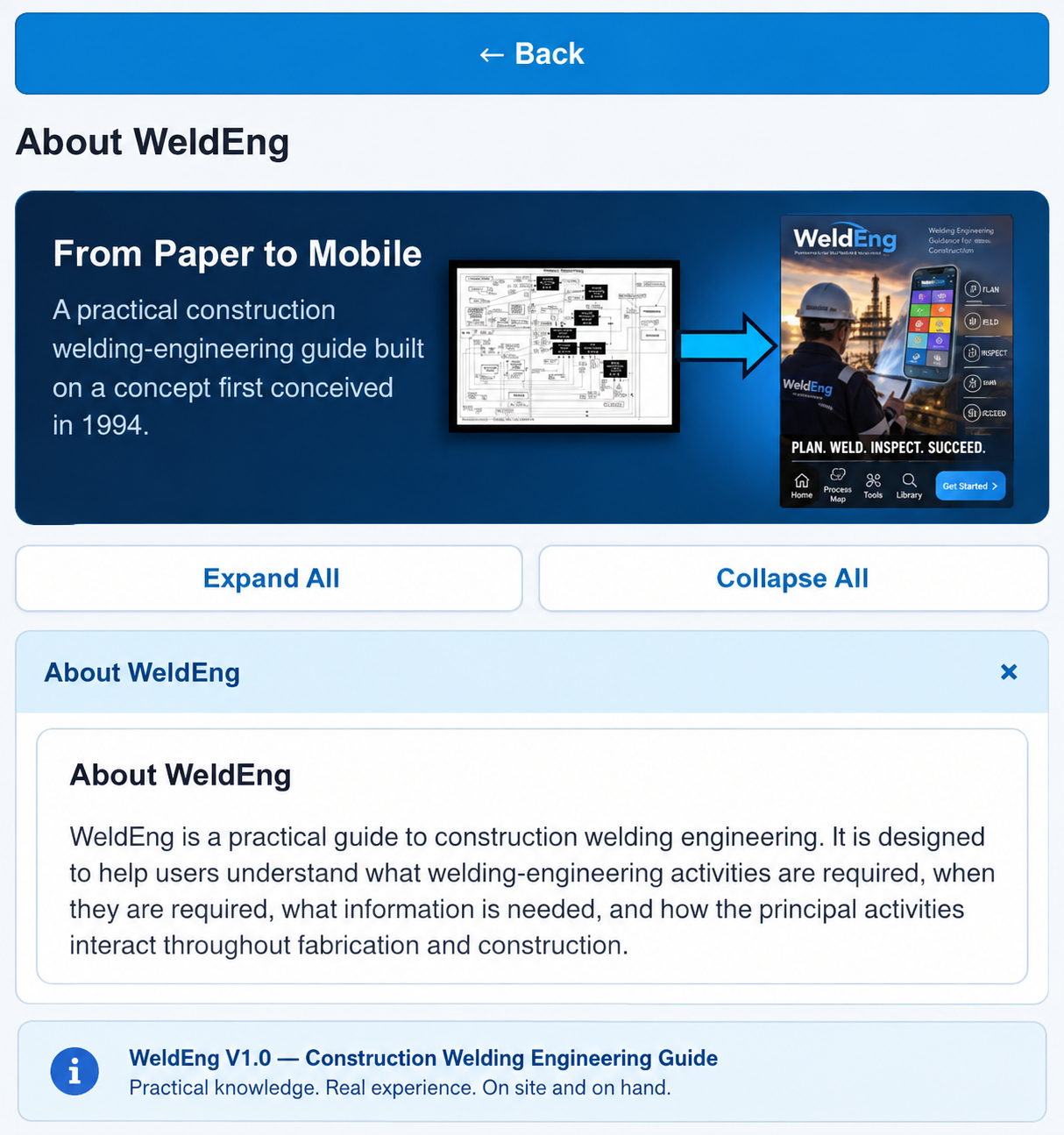
A practical construction welding-engineering guide built on a concept first conceived in 1994.
About WeldEng
WeldEng is a practical guide to construction welding engineering. It is designed to help users understand what welding-engineering activities are required, when they are required, what information is needed, and how the principal activities interact throughout fabrication and construction.
The Guide combines process-based engineering guidance with illustrated technical libraries, practical engineering tools and mobile field support.
The WeldEng Story — 1994 to Today
The original idea was to break the welding-engineering discipline into clearly identifiable activities and provide the engineer with a practical route through them. That same principle remains at the centre of WeldEng more than thirty years later.
Who is WeldEng for?
WeldEng is intended for graduate and trainee welding engineers, welding engineers and coordinators, welding inspectors and QC personnel, fabrication and site engineers, supervisors, technicians, and experienced personnel who need a practical welding-engineering reference.
It is particularly intended to help engineers developing their experience understand not only what a welding document or requirement is, but what the Welding Engineer needs to do next.
About the Author
Sam Leon is a Chartered Engineer and Fellow of The Welding Institute with extensive experience in welding engineering, fabrication and construction, particularly within the oil & gas and energy industries.
His experience includes welding procedure qualification and WPS/WPQR assessment, materials and consumables, welder qualification, fabrication and site support, weld repair engineering, technical investigations and welding quality management on UK and international projects.
He conceived the original Welding Engineering Process Map in 1994 and subsequently developed welding-engineering management systems including FusionWELD/WFMS. WeldEng continues that same objective: making practical welding-engineering knowledge structured, accessible and useful at the point where engineering decisions are made.
Welding Engineering & Management Systems Developed
WeldEng continues a long programme of welding-engineering, fabrication, quality and management-system development. Examples of systems, process maps and specialist functions developed over that period include:
This is a concise selection of the systems and functions developed over the wider programme; it is not intended as a complete software inventory.
Why WeldEng was developed
WeldEng was created to make practical welding-engineering knowledge easier to understand and access, particularly for engineers developing their experience in the discipline. It brings together methods, lessons and practical engineering approaches developed over a long career into a guide that can be carried and used wherever welding engineering takes place.
Important Information
WeldEng is an engineering guide and reference aid. It does not replace the applicable construction code, welding qualification standard, client or project specification, approved WPS, statutory requirements, competent engineering judgement, or site HSE procedures.
Product: WeldEng Mobile — Release Candidate 1
Developed by: Sam Leon CEng, FWeldI
Copyright: © 2026 Sam Leon. All rights reserved.
Privacy
Privacy Information
How the current WeldEng Mobile prototype handles information on your device.
Current Prototype Position
WeldEng Mobile is currently a guide-first application prototype. It does not require a user account and does not currently contain an online user database, analytics service, advertising service, payment system or cloud project-record system.
Local Working Data
Temporary field checklist states, Favourites/Notes and working field notes may be stored locally on the user's device using browser/app local storage.
Offline Content
The app shell may cache WeldEng files and assets locally so core guidance remains available when connectivity is poor.
No Current Account Upload
The present prototype does not upload those local notes/checklists to a WeldEng server.
Future Features
If future versions add accounts, cloud synchronisation, analytics, subscriptions or support messaging, this Privacy information will need to be revised before release.
Terms of Use
Using WeldEng
Core conditions and limitations for use of the WeldEng engineering guide.
Engineering Guide — Not Governing Authority
WeldEng is an engineering guide, learning aid and practical reference. It does not replace the applicable construction code, welding qualification standard, statutory requirement, client/project specification, approved WPS, ITP, manufacturer instruction, site HSE procedure or competent professional engineering judgement.
Verify Governing Requirements
Users remain responsible for confirming the current controlled edition of the applicable code, standard and project requirements before making production welding decisions.
Qualification Ranges
Where WeldEng explains WPS/WPQR or welder qualification logic, exact qualification ranges and essential-variable limits remain governed by the applicable standard.
Safety
WeldEng Safety provides awareness guidance only and does not replace site risk assessment, permits, COSHH/SDS controls, isolation, confined-space procedures or HSE authority.
Field Notes
Local field checklists and notes are working aids only. They are not formal project quality records unless separately transferred into the project's controlled documentation system.
Professional Use
Users should work within their competence and escalate matters requiring Welding Engineering, HSE, inspection, client or certifying-authority approval.
Intellectual Property
WeldEng text, original illustrations, process maps and application presentation are proprietary unless identified otherwise. Third-party codes and standards remain the property of their respective rights holders.
Support & Contact
WeldEng Support
Product support, technical feedback and correction reporting.
What to Report
Users should be able to report navigation problems, broken graphics, calculation issues, unclear guidance, potential technical errors, outdated references and suggestions for future WeldEng development.
Technical Content Feedback
Identify the module, topic and the exact statement or illustration requiring review.
Application Problem
Record device type, operating system, screen/page, action taken and what happened.
Standard / Code Update
Flag where a referenced standard has changed so the WeldEng guidance can be reviewed against the current controlled edition.
Support Contact
A dedicated WeldEng support email/contact route will be added before commercial release.


